
Check your error message
A lot of possible errors are currently logged and notified to the user. By reading the message, through the notification, you can handle by yourself some of these errors.
For example, in the error below, you can see that there was a timeout during the login process :
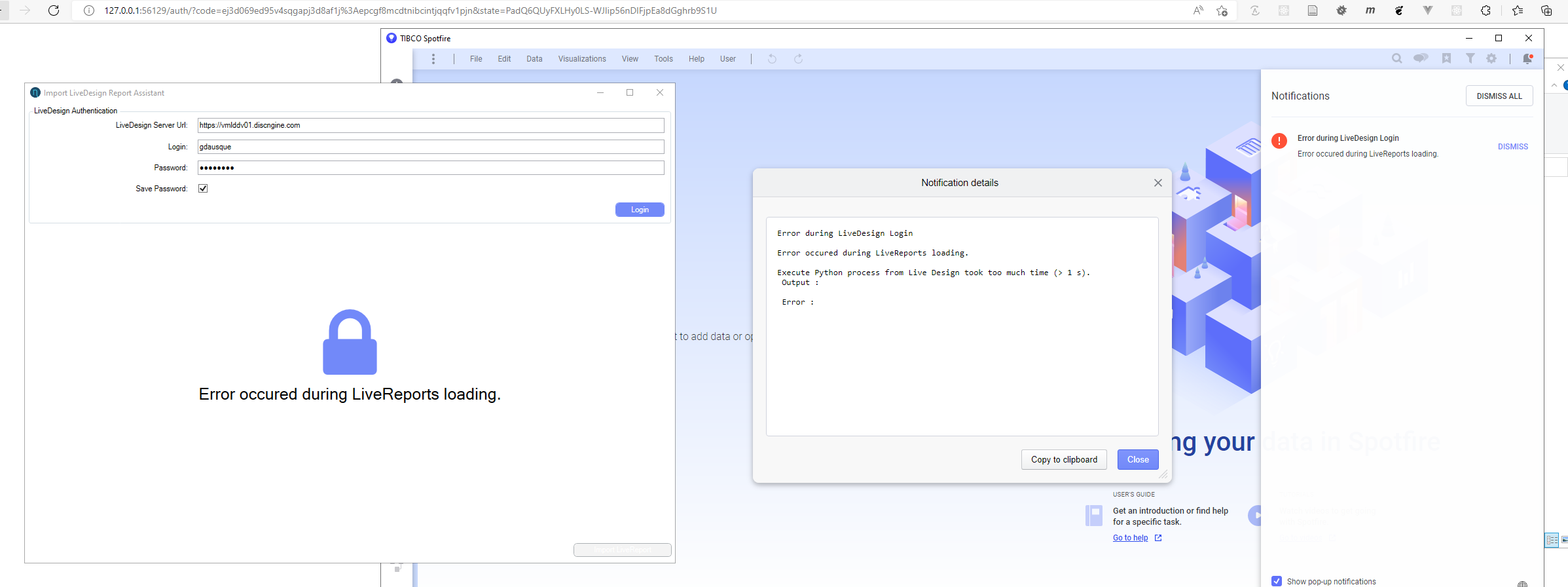
In this case, you have to increase the timeout value defined in the Spotfire preferences (see the installation documentation).
Check version of deployed gadget and Spotfire extension
This information can be very useful to help solve an issue after an update.
In Analyst :
- Go to Help > Support diagnostic and logging
- Note the version of the following assemblies :
- ClientAutomationCommon.Core
- Discngine.DataSource.LiveDesign
From the Gadget :
- Check the bottom of the gadget :

Use the Debug Helper analysis
If the LiveDesign Connector for Spotfire does not work as expected, you can use the debug analysis to make a first level diagnostic on its installation and configuration without the help of a Spotfire administrator.
Note that:
- this tool can be used for any Discngine Spotfire Connector product
- the scripts must have been trusted during the installation process
Depending on your issue, you can use the debug analysis either from the Analyst, the Web Player or the Spotfire Connector gadget from LiveDesign. The file is located in the Spotfire library at /LDConnector/Help/Debug Helper. Once opened, click on the "Run IronPython Script" button. This will retrieve your own configuration and installation for the current context.
In the page "👤 Groups and licenses" you will find:
- the user you are currently logged in as
- your roles
- the groups you are part of
- the license features enabled for you
In the page "⭐ Preferences" you will find:
- all your preferences and their values
- if the value applied is the default one or not (NA means there is no default value)
- if the preference is comming from a group or is specific to your user
- if the preference is local to the client (Analyst vs Web Player) or shared for the server
In the page "⚙️ Environment" you will find:
- the server you are connected to
- the deployment area you are connected to (note that in Analyst the name of the area is displayed, but in Web Player we can only retrieve the service instance identifier, which has to be communicated to a Spotfire administrator to know the corresponding area)
- all the modules loaded and their versions
In the page "✅ Discngine Products" you will find a summary of the installation and configuration status of each Discngine Spotfire Connector product:
- if the product is installed or not
- the installed version compared to the latest released version (to get it click on the "Get Latest Versions from Web" button)
- if all the modules are installed
- if all the license keys are valid
- if all the required license features are enabled
If needed, you can send us this file via email. To do so, make sure to run the 2 scripts, click on "File > Save as > File" and attach the created file to the email.
Use the diagnostic tool
If the Connector doesn't work correctly, you can use the diagnostic tool to make a first level diagnostic on the installation and configuration of the Connector.
To use the diagnostic tool, launch Spotfire Analyst and go to Discngine > LiveDesign Connector diagnostic tool.
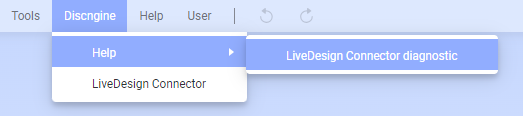
If you have not yet made the necessary settings, follow the diagnostic tool configuration guide.
Run the diagnostic by clicking on the "Run Check" button. All configured diagnostics start running.
When the diagnostics are complete, a report is available for each control and its status. In the event of an error or warning, a message helps you to understand and resolve the issue.
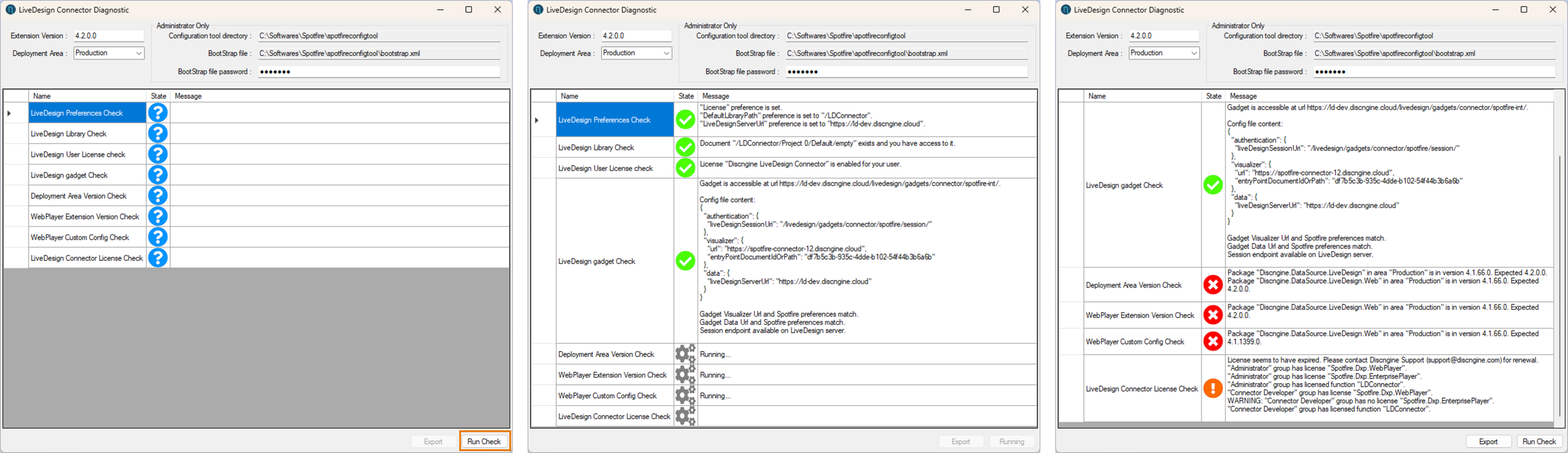
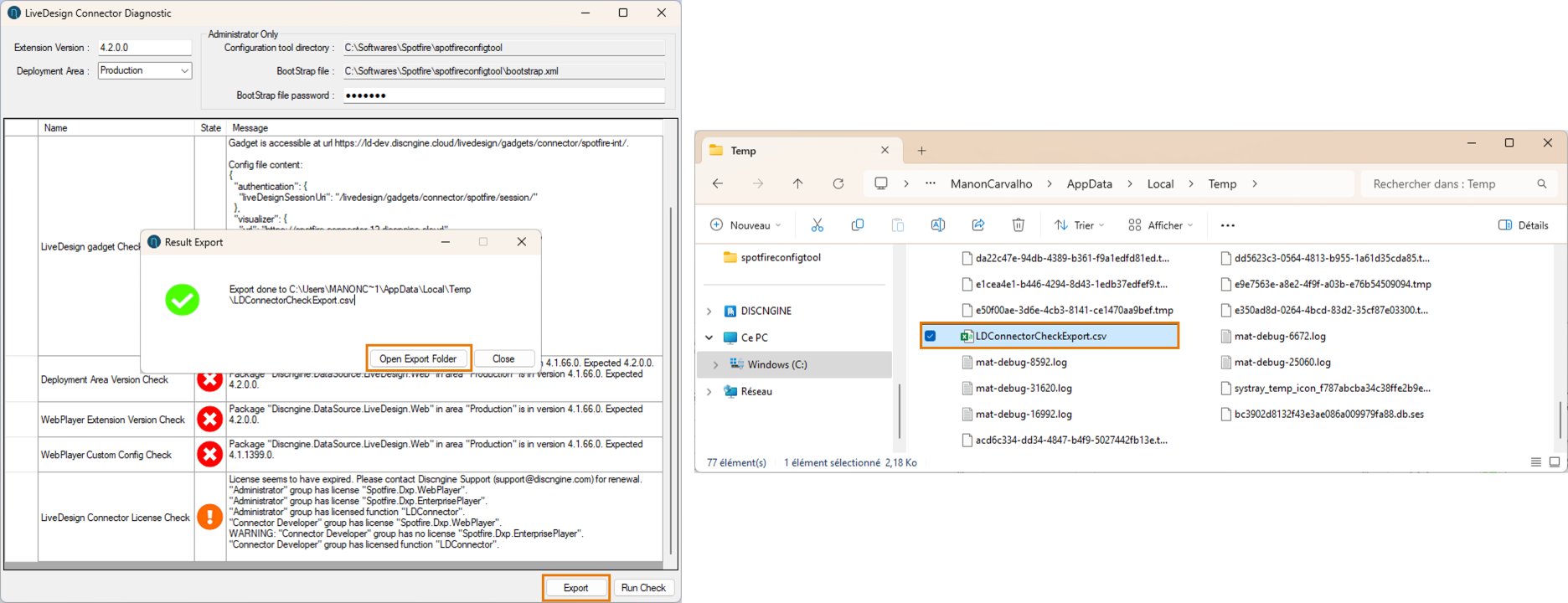
You can also export the diagnostic results in CSV format to send it to support@discngine.com.
Click on "Export" to generate the CSV file. It is saved in the temporary folder of your account in the LDConnectorCheckExport.csv file.
You can click on "Open Export Folder" to open the folder location.
Check the LiveDesign configuration
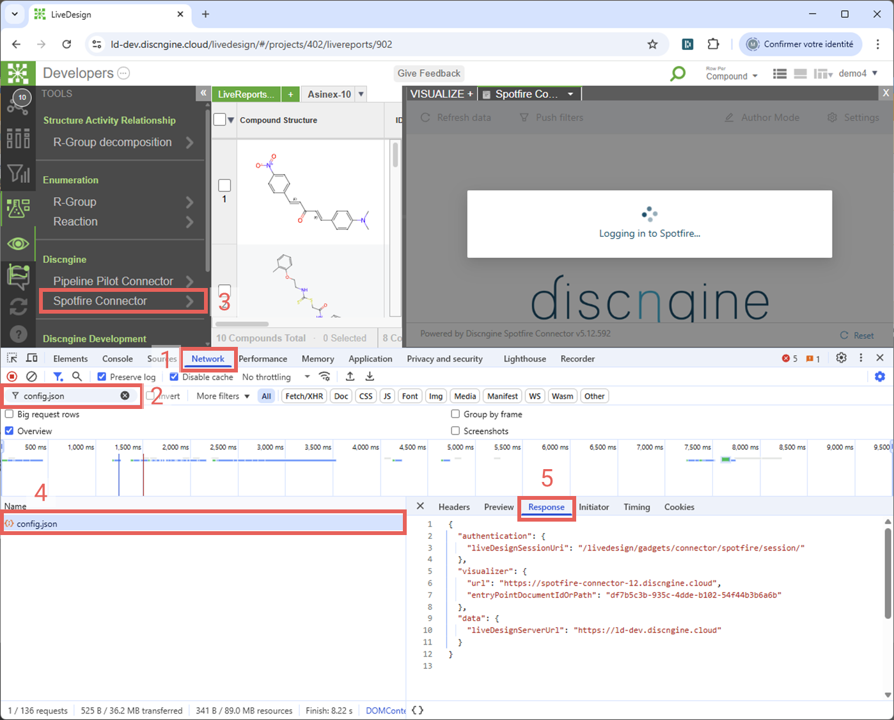
When the gadget is not working properly, you can check the config.json file.
Get the config file
From LiveDesign interface:
- Open the DevTools (Ctrl F12 or Right click and Inspect) and go to the Network tab
- Filter on config.json
- Open the Spotfire gadget (the name might be different than the one in the screenshot)
- Click on the config.json entry which just appeared
- Open the Response tab
Points of attention
liveDesignServerUrlvalue must be the same than the first part of the URL in your browservisualizer > urlvalue should be the Spotfire server where the Connector is installed and, most of the time, it should not end with a slash- The
entryPointDocumentIdOrPathvalue must be the GUID of an accessible Spotfire document - Pasting
liveDesignServerUrlvalue followed byliveDesignSessionUrivalue in a browser should display a page with a long string- If you get a 404 error code, then the
liveDesignSessionUrivalue is wrong - If you get another error code, like 503, there might be an issue with the LiveDesign nginx server
- If you get a 404 error code, then the